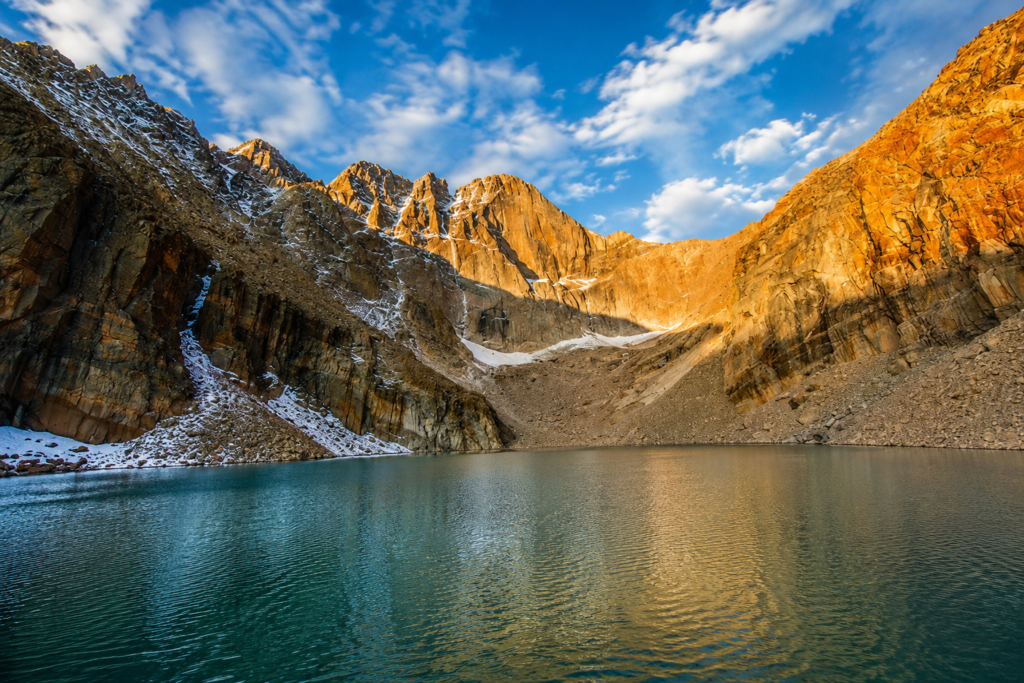
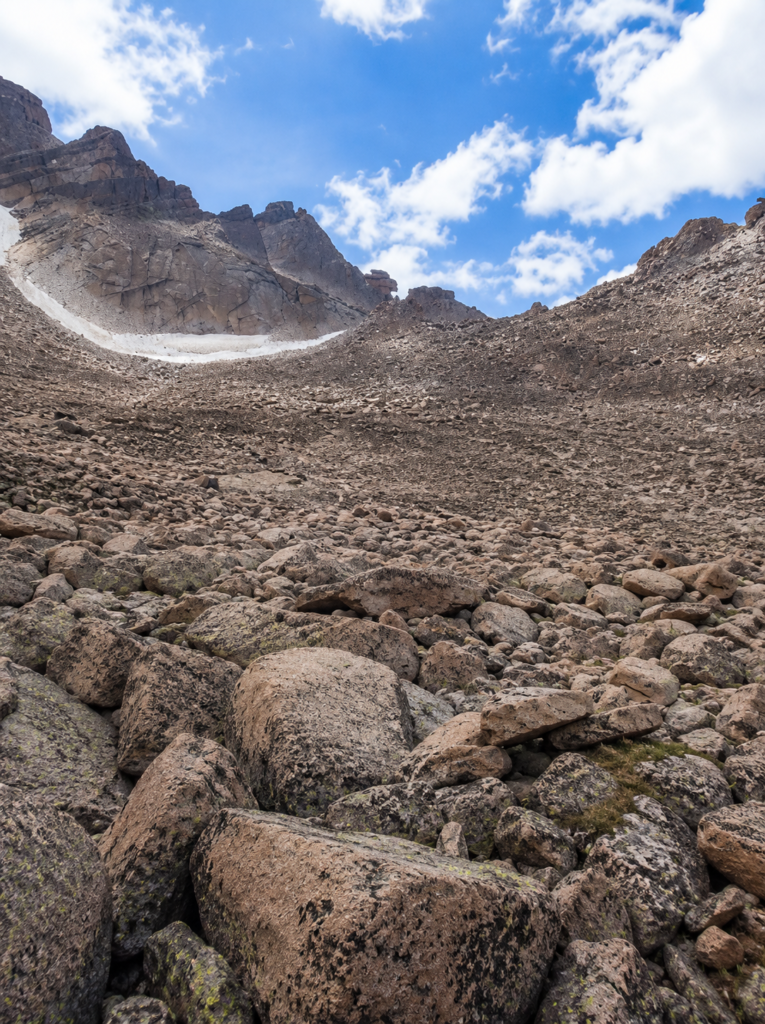
You share the trailhead with people attempting one of Colorado’s deadliest fourteeners, and for the first 3.4 miles you’re literally on the same path. Then the Chasm Lake Trail splits off, the crowd headed for the summit keeps climbing toward the Boulder Field and the Keyhole, and you get the easier version of this mountain, still hard, just not technical-climbing hard.
The numbers
Roughly 8.2 miles round trip from the Longs Peak Trailhead, about 2,600 feet of gain, starting at 9,400 feet and topping out around 11,800 feet at the lake itself. NPS and most guides call this strenuous, and altitude is doing a lot of that work, the actual grade isn’t brutal, but thin air at 11,800 feet makes easy things feel harder than they should. About two-thirds of the route sits above treeline, so you get big views most of the way, across the Front Range one direction and out toward the plains the other, but you also get full sun exposure and zero shelter if weather turns.
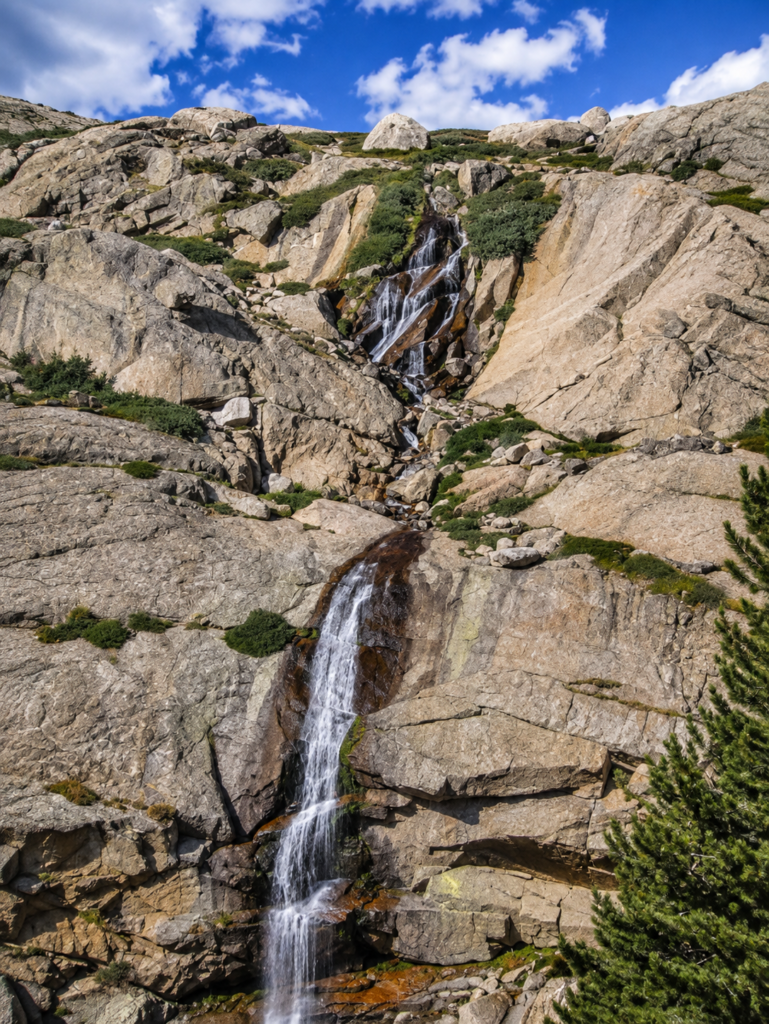
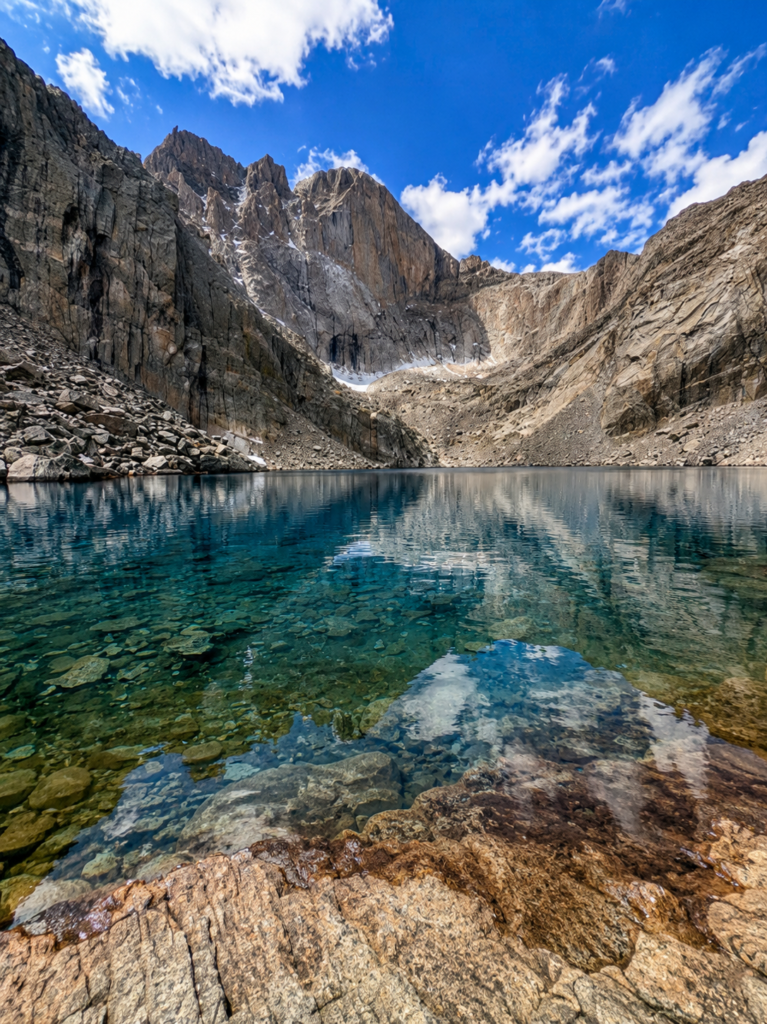
The trail passes Columbine Falls and a spot called Peacock Pool before one last short, steep scramble up a rock outcropping. Then Chasm Lake appears all at once, sitting in a glacial bowl with the Diamond rising directly above it.
What’s actually looming over you
The Diamond is the sheer upper face of Longs Peak’s east side, over 900 feet of vertical granite starting above 13,000 feet. For years nobody climbed it, not because nobody wanted to, but because the National Park Service banned it outright starting in 1954, worried about the difficulty of rescuing anyone who got in trouble up there. The ban held until 1960, when Dave Rearick and Bob Kamps finally got permission and spent three days on the wall making the first ascent, a climb significant enough that it made newspapers across the country. The route they established, now called D1, ended up in a book literally titled Fifty Classic Climbs of North America. Look up from the shore of Chasm Lake on a summer day and there’s a decent chance you’ll see actual climbers on that wall, tiny and slow-moving against all that granite.
At the base of the Diamond sits Mills Glacier, one of fewer than 50glaciers left in Colorado, feeding directly into the lake below it.
A death that got a shelter named after it
In January 1925, a climber named Agnes Vaille became the first woman to complete a winter ascent of the east face. She made it to the top. On the descent, in brutal cold and wind, she fell and injured herself badly enough that she couldn’t continue. Her partner went for help. By the time rescuers reached her, she’d died of exposure. One of the men who went looking for her, Herbert Sortland, broke his hip in the search and also froze to death before anyone found him. The Park Service built a stone shelter near the Boulder Field two years later, named for her, partly as a memorial and partly because there’d been enough deaths on this mountain by then that they wanted hikers to have somewhere to take cover. It’s still there.
Before you go
Start early, ideally by 7am. Afternoon thunderstorms build fast in summer, typically by 2pm, and you want to be back below treeline before that happens, not deciding whether to push on toward the lake while lightning is a possibility. Cell service is close to nonexistent for most of the hike. No dogs, standard for this park. Parking at the Longs Peak Trailhead fills brutally early, especially on weekends, arrive before dawn or plan on parking along the road. Rocky Mountain National Park has used timed entry vehicle reservations for parts of the park in recent years, check current requirements before you drive up expecting to just show up. Late June through September is your best window, snow can linger into midsummer some years.
Did you spot any climbers on the Diamond while you were there, or was the wall socked in? Tell us what you saw. 👇