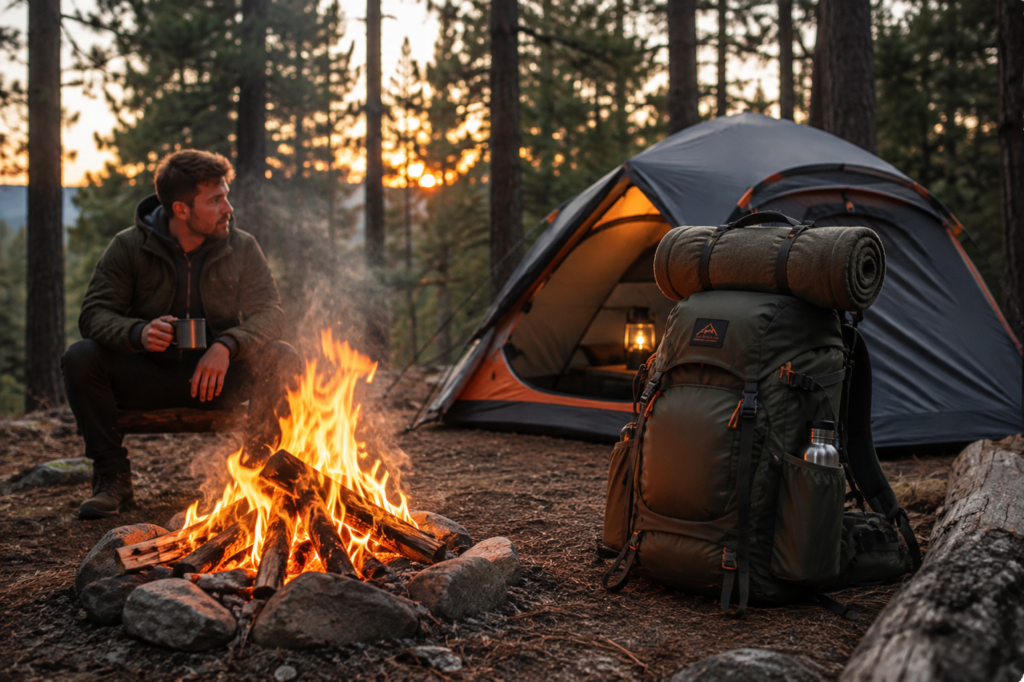
These are the best backpacks 50-70L for multi-day backpacking right now, and none of them got picked at random. Four packs, cross-referenced against professional gear labs and thousands of real buyer reviews. OutdoorGearLab, Switchback Travel, and Better Trail have run these exact models through hundreds of trail miles, heavy-load stability trials, and multi-year durability checks. That research gets cross-referenced against real Amazon buyer reviews below, so you’re seeing the same picture we saw, not a guess dressed up as a recommendation. The price through our links is identical to buying direct, we just did the scrolling-through-hundreds-of-reviews part for you.
Quick Pick
- Best overall for multi-day trips: Osprey Atmos AG 65
- Best for hauling heavy loads (35+ lb): Gregory Baltoro 65
- Best balance of comfort and lightweight: Osprey Exos 58
- Best budget option: TETON Sports Scout 3400
| Pack | Capacity | Weight | Best For | Rating |
|---|---|---|---|---|
| Osprey Atmos AG 65 | 65-68L | ~4.5-4.9 lb | All-around multi-day trips | 4.8★ |
| Gregory Baltoro 65 | 65L | ~4.75-4.9 lb | Heavy loads, expeditions | 4.8★ |
| Osprey Exos 58 | 58L | ~2.5-3 lb | Lightweight without going ultralight | 4.6★+ |
| TETON Sports Scout 3400 | ~55L | ~4.5 lb | First multi-day pack on a budget | 4.5★ |
Osprey Atmos AG 65 — Best Overall
This is the pack that kept winning “best overall” across independent testing labs, and the reasoning stays consistent: an Anti-Gravity trampoline-style mesh back panel that keeps real airflow moving even on a hot, loaded climb, a 210-denier nylon body reinforced at the base, a rain cover included standard, and Osprey’s lifetime “All Mighty Guarantee” warranty, considered one of the most generous in the industry. Independent testers rated it their top overall pick two years running. The recurring caveat: it’s genuinely one of the pricier options here, and the hip belt pockets run smaller than some hikers want.
Pros
- Exceptional ventilation
- Reinforced durable base
- Rain cover included
- Lifetime warranty
- Comfortable for multi-day loads
Cons
- One of the more expensive options
- Small hip belt pockets
- Less stable than the Baltoro above 40 lb
Gregory Baltoro 65 — Best for Heavy Loads
Where the Atmos wins on ventilation and weight, the Baltoro wins the moment your pack crosses 35 pounds. Its FreeFloat pivoting hip belt and more structured suspension are built specifically for carrying heavier, longer expeditions comfortably, and it comes with noticeably more external organization than the Atmos, more pockets, a U-zip front panel for full access without unpacking from the top. One thing worth checking before you buy: sources differ on whether a rain cover ships standard with every version, so confirm this on the current listing rather than assuming.
Pros
- Superior stability under heavy loads
- Excellent organization and pocket access
- Bomber build quality
- Comfortable hip belt for 5+ day trips
Cons
- Heavier than the Atmos
- Stiffer foam padding
- Rain cover inclusion varies by listing, check before buying
Osprey Exos 58 — Best Balance of Comfort and Lightweight
Built for the hiker who wants real multi-day capacity without carrying the extra pound or two that comes with a fully padded pack like the Atmos. It strips down the frame and padding just enough to shave real weight while keeping enough structure that loaded comfort doesn’t fall apart the way it can on true ultralight packs. It won’t carry 40+ pounds as comfortably as the Baltoro, and that’s the tradeoff, less pack means less built-in support at the extremes.
Pros
- Noticeably lighter than full-suspension packs
- Still genuinely comfortable loaded
- Simple, fast-access design
- Good for hikers moving toward lighter setups
Cons
- Less padding for heavy loads
- Fewer pockets than the Atmos or Baltoro
- Not a true ultralight pack if that’s specifically what you want
TETON Sports Scout 3400 — Best Budget Option
Worth being upfront about one thing: this pack runs closer to 55 liters than a true 65-70L, so if you need the full capacity, size your expectations accordingly. What it does deliver, consistently, across years of owner reviews, is real multi-day functionality at a fraction of the price of the premium packs above, a sleeping bag compartment, a built-in rain cover, a hydration sleeve, and a genuine lifetime warranty.
It won’t match the suspension comfort of an Osprey or Gregory under a heavy load, and several reviewers note the buckles and zippers feel noticeably cheaper. For a first multi-day pack, or a backup pack you’re not precious about, it consistently earns its price back. If this is your first multi-day trip, our general packing checklist covers the categories you’ll need to fill.
Pros
- Much cheaper than premium options
- Includes rain cover and sleeping bag compartment
- Lifetime warranty
- Widely rated 4.5 stars on Amazon
Cons
- Closer to 55L than 65-70L
- Less comfortable under heavy loads
- Buckles and zippers feel budget-grade
- Rougher fabric than premium packs
A Quick Note on Sizing
All of these packs run in men’s and women’s-specific versions, and torso length matters more than height for getting the fit right. The women’s equivalents are the Osprey Aura AG 65 (matching the Atmos), the Gregory Deva 60 or 70 (matching the Baltoro), and the Osprey Eja 58 (matching the Exos), each with a shorter torso range and a hip belt shaped differently, not just a different color. A common mistake is sizing based on height instead of measuring actual torso length per the manufacturer’s chart. Every brand here publishes one, check it before ordering, it’ll save a return.
FAQ
Do I actually need 65L, or would something smaller work?
If you’re out for more than 3-4 nights, or you’re carrying bulkier gear like a bear canister or winter layers, 65L gives you room without stuffing it. For weekend trips under 3 nights, a 40-50L pack usually carries lighter and just as comfortably, worth reading our guide to packs under 40L if that sounds closer to your trips.
What’s the real difference between the Atmos and the Baltoro?
Weight and ventilation versus raw load-carrying comfort. The Atmos is lighter and cooler on your back; the Baltoro carries heavier loads more comfortably and organizes gear better. Most backpackers who stay under 35 pounds loaded lean Atmos. Anyone regularly pushing past that, especially on multi-week trips, tends to prefer the Baltoro.
Is the TETON Sports Scout 3400 actually good enough for a real backpacking trip?
For a first multi-day trip or an occasional-use backup pack, yes, reviewers consistently report using it for multiple nights without issue. It won’t match the comfort of the premium packs above under a heavy load over many days, but it’s a functional, well-reviewed way to try backpacking before spending $300+
Final Thoughts on the Best Backpacks 50-70L
All four of these earned their spot through independent testing and real multi-day use, not guesswork.
Which one matches how you actually pack, someone who counts ounces, or someone who’d rather carry a little extra weight for a little extra comfort? Tell us in the comments, and if you’ve owned any of these four, we’d genuinely like to hear how they’ve held up over real miles. 👇