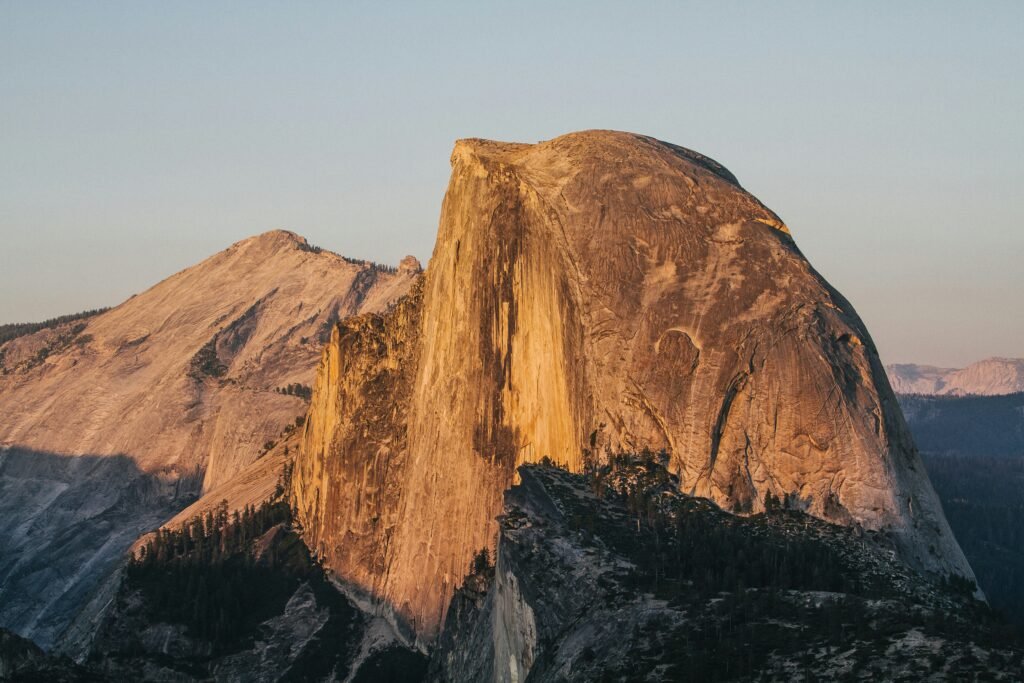
George Anderson drilled the first eyebolts into this rock by hand in October 1875. Bare feet coated in pine pitch for grip, on granite everybody else had already written off as unclimbable. He got up it. Sally Dutcher followed a few weeks later, first woman to stand on top, with Anderson leading her up his own route. The Sierra Club swapped his eyebolts for the steel cables that are still bolted in today back in 1919. We think about that sometimes, hands wrapped around the cable, halfway up 400 feet of bare rock, sweating through our shirts.
Half Dome is the rock on every Yosemite postcard. It’s also the hardest day hike either of us has ever finished, and it’s not close.
The numbers
14 to 16 miles round trip from Happy Isles, depending which route you take up and down. About 4,800 feet of gain. Summit’s at 8,846 feet. Most people are out there 10 to 14 hours, car to car. Almost all of it uphill on the way out.
Getting a permit is its own separate ordeal
You can’t just show up once the cables are up. NPS caps it at 300 people a day – 225 day hikers, 75 backpackers – and you need a permit to go past Sub Dome. There’s a preseason lottery in March for the whole season, and a smaller daily lottery two days out if you didn’t plan ahead. We’ve entered that daily lottery more times than we want to admit before finally getting a yes. Plenty of hikers who are more than fit enough for this trail never get the chance to try it. Plan for the permit like it’s its own project, separate from training for the hike.
The route, waterfall by waterfall
Most people go up one trail and down the other. Mist Trail is shorter and steeper, straight past Vernal Fall on granite steps that are genuinely slick with spray – over 600 of them before you clear the top of the falls. John Muir Trail is longer but drier, with better views back down the canyon. Either way you’ll hit Nevada Fall next, then Little Yosemite Valley, last water and last shade you’ll see. After that it’s a long, exposed climb up granite switchbacks to Sub Dome. That’s where it stops being just hard.
The cables
You see them before you reach them – two steel cables running 400 feet up the granite, wooden crossboards spaced out for footing. Photos don’t do the exposure justice. It’s also less technical than it looks once you’re actually on it, hand over hand, one board at a time.
The one thing we’re not going to soften
Lightning kills people on those cables. It’s happened more than once. That’s the real risk here, more than the exposure or the crowds. Afternoon storms build fast over the Sierra in summer, and there’s nowhere worse to be than 8,846 feet of exposed granite when one hits. If you get to Sub Dome and the sky looks off, turn around. Come back next season. Don’t gamble on that elevation.
When to go
Cables go up the Friday before Memorial Day, come down the Tuesday after Columbus Day — trail crews physically pull them every October. Outside that window you’re climbing, not hiking. If the lottery gives you a choice, take a weekday. Weekends can mean an actual line at Sub Dome waiting for cable space, which is miserable after nine miles.
What we’d tell a friend
Start before sunrise. Not to sound tough – you want to be off those cables and back down past Little Yosemite before any storm has a chance to build. Carry more water than seems necessary, there’s nothing past Little Yosemite. And put in a long, steep training hike beforehand if you’re not already doing that kind of mileage – 4,800 feet in one push finds every weak spot in undertrained legs.
Bottom line
Half Dome deserves the reputation. The permit is a hassle, the distance is real, the cables are as exposed as everyone says. It’s also got 150 years behind it, from a barefoot Scotsman with pine pitch on his heels to a Sierra Club crew stringing cable in 1919. You feel that standing up there, even if you can’t quite explain why.
Did your permit come through first try, or did it take you a few shots at the lottery like it took us? Tell us in the comments. 👇