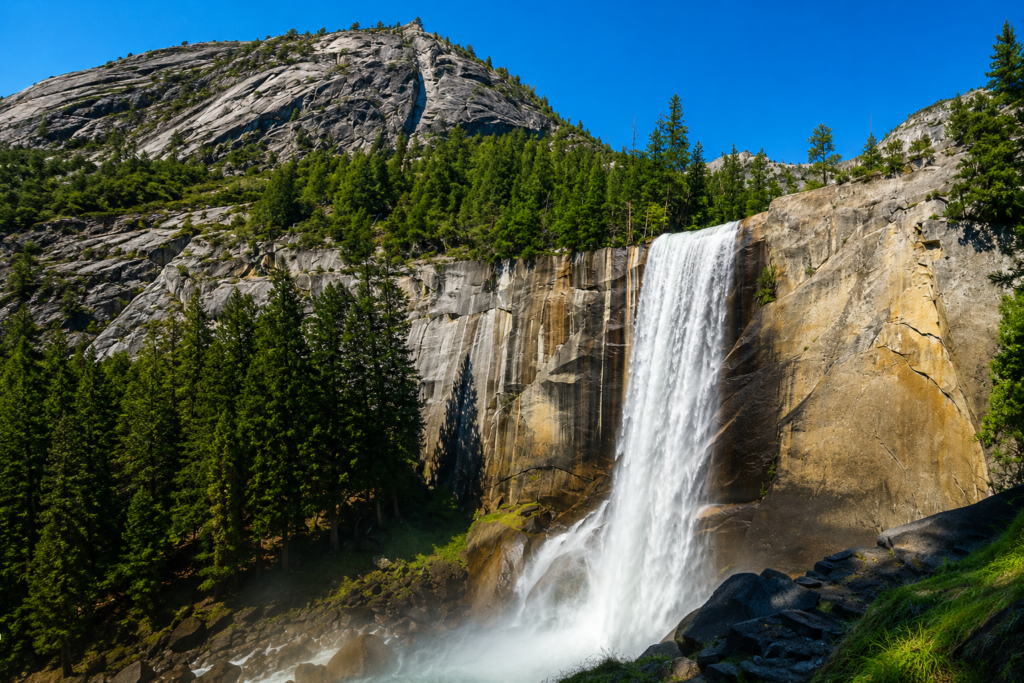
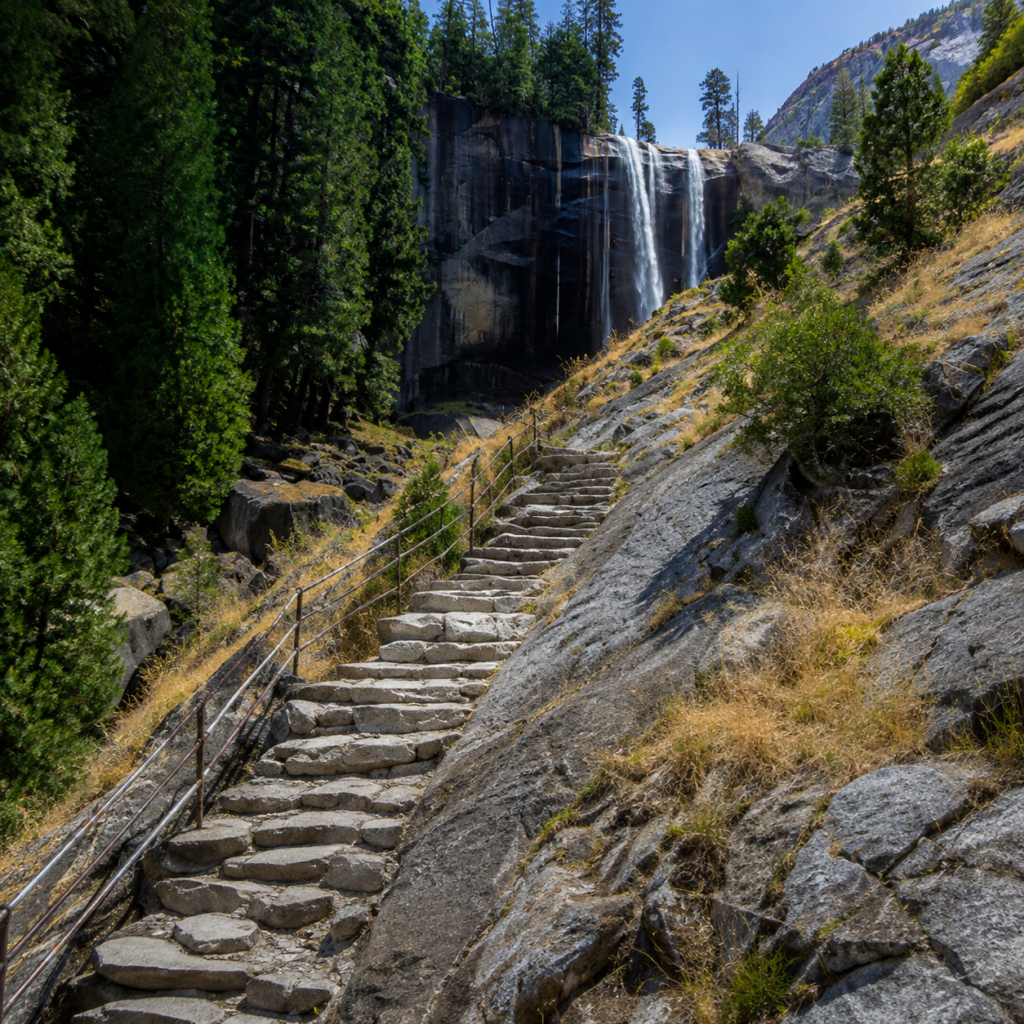
Nobody hikes the Mist Trail expecting to arrive dry, and that’s the whole point. Somewhere around the base of Vernal Fall, the spray coming off 317 feet of falling water hits a set of stone steps carved straight up alongside it, and for a few hundred feet you’re climbing through what’s basically a controlled rainstorm on a sunny day. Bring a poncho if you care about your phone. Don’t bring one if you don’t mind getting soaked, because you will get soaked either way, just less gracefully.
Where people actually stop
This trail has built-in off-ramps, which is part of why it’s so popular with everyone from serious hikers to families with strollers, at least for the first stretch. The footbridge at 0.8 miles gives you a real view of Vernal Fall for a 400-foot gain, easy enough for almost anyone. Push on to the top of Vernal Fall itself and you’ve done roughly 2.4 to 3 miles round trip with 1,000 feet of gain, most of it on those granite steps. Keep going to the top of Nevada Fall and you’re looking at 7 miles round trip and about 1,900 feet total, which is where this stops being a casual outing and starts being an actual hike.
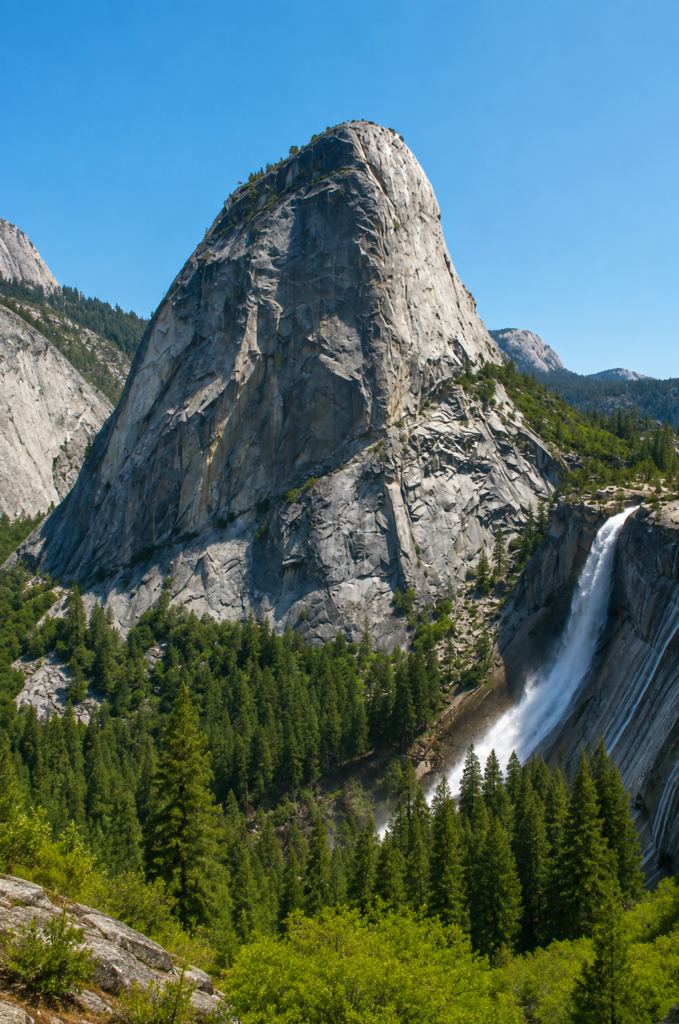
Most people turn around at Vernal Fall. That’s a completely reasonable place to stop. The people who continue to Nevada Fall get a quieter trail, a bigger waterfall (594 feet, nearly double Vernal’s height), and views of Liberty Cap along the way, but they also earn every foot of that extra elevation.
One scheduling detail that’ll wreck your plans if you don’t check it
In recent years, the upper section of the Mist Trail near the Vernal Fall junction has been closed Monday through Thursday, 7am to 3:30pm, from late July through October, open only Friday through Sunday and holidays. This isn’t a permanent rule and it shifts year to year depending on trail work, so check the NPS current conditions page before you drive out expecting a Tuesday hike. Hikers can usually detour around the closure via the John Muir Trail, but that’s not the same experience you came for.
Names with a complicated backstory
Both falls got their English names in 1851 from Lafayette Bunnell, a doctor riding with the Mariposa Battalion, a militia unit sent into this valley specifically to force the Ahwahneechee people out of it. Whatever else you think about that mission, Bunnell clearly noticed the scenery: he named Vernal Fall for its spring-like mist and green edges, and Nevada Fall for looking like an avalanche of snow sliding down toward the Sierra Nevada. The Ahwahneechee already had names for both, Yan-o-pah for Vernal, meaning something like “little cloud,” and Yo-wy-we for Nevada, describing the twisting motion of the water. Both names existed before 1851. Only one set made it onto the park signs.
The trail itself has its own separate history, one involving entrepreneurs instead of soldiers. In 1870, a man named Albert Snow built a horse trail up from the base of Vernal Fall over to the flat ground between the two waterfalls, and put a hotel there called La Casa Nevada. A year later, John Conway extended the route up to the top of Nevada Fall. Both were toll trails, built for profit during Yosemite’s earliest tourism boom, decades before anyone thought to build a paved road into the valley. The hotel is long gone. The route mostly isn’t.
Practical stuff
No permit needed, no dogs allowed, and don’t swim above either waterfall no matter how calm the water looks from the bank, people have drowned going over the edge because the current above a 300-plus-foot drop is stronger than it appears. Carry water, real water, not the fountain at the footbridge, which the park can shut off without notice if the water gets cloudy. Spring gives you the biggest, loudest version of both falls from snowmelt. By late summer, Vernal Fall in particular can thin out and split into separate strands instead of one solid curtain, which is still pretty, just a different kind of pretty.
Vernal Fall only, or did you push on to Nevada? Tell us where you called it. 👇